
Looking Back, Moving Forward: KESKfEST 2026 Conversations
Updated: Sep 2
Update #297
Looking back at our shared roots while clear-eyed about what’s next.

KESKfEST 2026 transformed Toronto into the vibrant heart of a community that hadn’t gathered at this scale in North America for 25 years. It was a week of looking back at our shared roots while clear-eyed about what’s next.
While the concerts and performances brought the energy, the daytime luncheon series in the festival tent (just across from the future home of KESKUS) became the space for the real work. From a live Paikin Podcast regarding national security to sustainable fashion, these conversations—including the "Uued Tuuled: Future Forum" and "Nordic Connect"—showed a community ready to lead.
Here is a look at the ideas that will stay with us long after the tent is packed away. If you want to read our blog recap on all the events outside the panels, read here. For our recap focused on Valguspidu (Celebration of Light), click here.
Beyond the Frontlines: Security, Technology, and Society
Steve Paikin, host of The Paikin Podcast, brought his seasoned perspective to the stage for a conversation with Estonia’s Minister of Education and Research, Dr. Kristina Kallas. One of the key discussion points involved Estonia’s strategic partnership with OpenAI.
Kallas was firm: AI is a tool to be mastered, not a replacement for the teacher. In Estonia, the priority remains building the critical thinking skills that technology can support but never replicate. This discussion was recorded for The Paikin Podcast, keep an ear out for the full episode.
The session opened with remarks from co-author of Lessons from Estonia's Education Success Story: Exploring equity and high-performance through PISA, Peeter Mehisto and closed with insights from Canadian defence entrepreneur and executive, Kath Intston, both bringing their unique Estonian-Canadian perspectives to the stage.
Minister Kallas also spoke personally about her upbringing in a Russian-speaking region of Estonia, illustrating why national security is about more than just defence budgets. For a border nation, resilience is found in a rock-solid societal identity and active citizenship. This cultural strength is reflected in Estonia’s top-tier PISA rankings—a success Kallas attributed to a national culture that treats education as a non-negotiable priority.
Urban Belonging: Designing the Places We Call Home
At the Urban Belonging luncheon, we asked a fundamental question: What makes a city feel like home? KESKUS lead architect Alar Kongats and Tõnis Arjus, Estonia’s first State Architect, pushed back against the "anonymous glass box" trend in modern development. They advocated for identity-driven design—the kind of expressive vision that defined Uno Prii’s legacy and now serves as the foundation for KESKUS International Estonian Centre.
Moderated by Elsa Lam, Editor-in-Chief of Canadian Architect, the panel explored KESKUS as a "north star" for global Estonians and a gift to Toronto. By integrating a new public walking path between major transit hubs, the project prioritizes community over profit. As urban planner Eric Sehr noted in his opening and closing remarks, the built environment is the literal framework for the sense of belonging we are creating here.
Circular Threads: Sustainable Estonian Design
With Canadians discarding roughly 37 kilograms of fabric per person each year, our Saturday luncheon took a hard look at the fast-fashion crisis. The Circular Threads event showcased a different path, combining a gourmet meal (part of our daily luncheon series) with a live editorial shoot by NYC fashion photographer Mauricio (“Maury”) Zelaya to demonstrate the beauty of the circular economy.
Special recognition goes to the global youth delegates who modelled in the live shoot: Stella Nahkur (images 1,9), Katrina Laur (images 3,7,10), and Erik Stenqvist (images 2,3,7). Check out Maury’s Instagram post here which includes all the handles for the Estonian designers and models involved with the show.
The panel, moderated by The Kit’s Annika Lautens (Canadian-Estonian), featured sustainable fashion pioneer Dr. Reet Aus and fashion director, environmentalist, and sustainability consultant Sarah Jay. They demystified "circularity," focusing on stopping waste at the source. Dr. Aus’s UPMADE® certification is a blueprint for this, proving that industrial leftovers can become high-quality garments using a fraction of the water and energy required by traditional manufacturing.

The discussion pitted our "throwaway" culture against Estonia’s zero-waste approach. Attendees left with real-world tips for spotting greenwashing and plenty of inspiration to shop for quality, local or secondhand items rather than chasing the latest trends.
Designers Reet Aus and Eva Karlotta-Tatar also hosted “Denim Reborn!” workshops right beside KESKUS where people brought in their old jeans and transformed them into beautiful tote bags.
Nordic Connect Conference
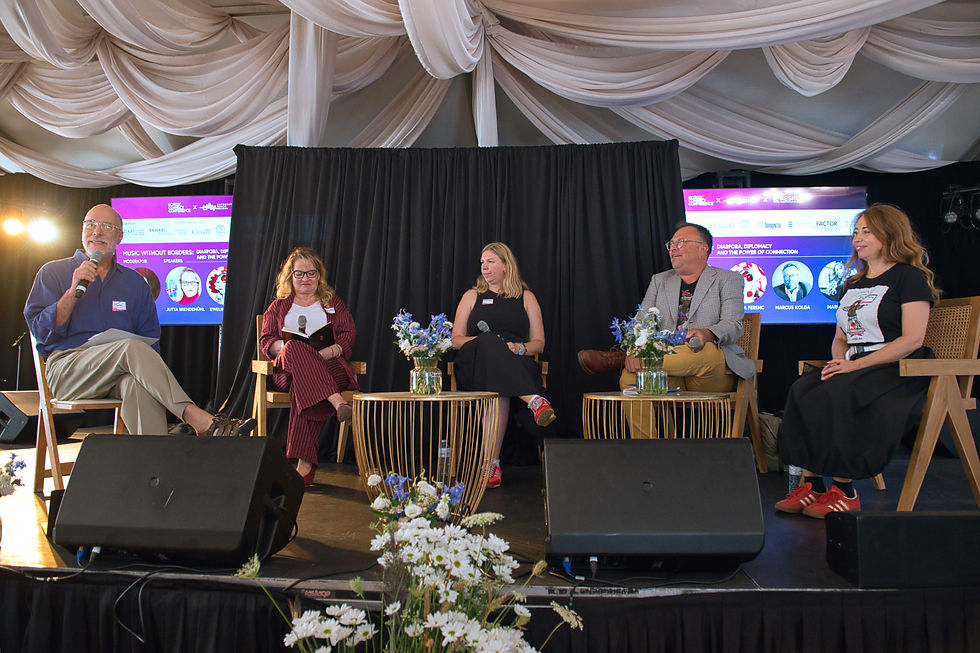
At the Nordic Connect Conference, the "Music Without Borders" keynote became a deeply personal exploration of how culture and politics are inseparable. Moderated by CBC’s Tom Allen, a panel of artists and advocates—including Jutta Brendemühl, Marichka, Marcus Kolga, and Ewelina Ferenc—reflected on how shifting geopolitical tensions and the war in Ukraine directly shape their creative work.
Perhaps the most haunting moment was Marichka’s account of using music to tell the story of the thousands of Ukrainian children abducted by the Russian government. It was a visceral reminder that art can make overwhelming human tragedies personal and accessible when numbers fail. Tom Allen also observed that many Canadians lack a deep understanding of the historical experiences of those from Central and Eastern Europe—histories of displacement and resistance that continue to define our worldview today.
By sharing our identities and traumas through art, we aren't just looking inward; we are building connections with the broader Canadian public. It’s clear that while we have more work to do to engage younger generations, we have a pathway to keep our culture fiercely relevant.
Uued Tuuled: Future Forum

The Uued Tuuled: Future Forum served as a powerful closing to the festival’s daytime series, marking a transition from celebrating heritage to accepting collective responsibility for the nation’s survival. With a room fuller than anticipated and high levels of engagement, the event successfully brought generations together, fostering the deep sense of connection vital for diaspora communities. This was the moment where the next generation embraced a "Meie kord!" (Our turn) mentality, ready to carry the weight of a nation forward in an increasingly complex world.
The forum was anchored by a deep-dive into the critical pillars of Estonian resilience. Minna-Liisa Herman of the Ministry of Defence addressed poignant questions regarding national security, including changing perspectives on military service and the potential for women's mandatory service. Shifting to technology, Karl Vilhelm Valter of GScan highlighted the strength of the Estonian education system, particularly the unique ability of students to move fluidly between STEM and the arts, such as music. He also noted that for Estonians, studying abroad is a valuable asset for broadening perspectives and bringing fresh innovation back home.

The conversation also tackled the logistical and emotional challenges of global cohesion. Kaisa Kasekamp, President of the Estonian Worldwide Youth Network, explored how a scattered diaspora can remain practically engaged. The panelists emphasized that culture is not a luxury in times of crisis—it is one of the reasons it’s worth preserving and protecting our country in the first place. However, the panelists emphasized that culture does not survive on its own—each generation must actively recreate and pass it on.
Joined by youth delegates from diverse professional backgrounds, the panel showcased a mix of "on-the-field" and "abroad" experiences. It demonstrated that while generations are changing, the fundamental value placed on Estonian culture remains constant. The forum faced a harsh reality: Estonia’s future won’t be maintained by default. It requires the active participation of those willing to lead.

As the festival tent is packed away, the impact of these conversations continues. KESKUS is emerging as more than just a building; it’s a vibrant cultural hub in the heart of Toronto, built to share our insights, traditions, and future-thinking with the entire city and the global Estonian community alike.
To view photo galleries and more KESKfEST recaps and follow updates as we approach the opening of KESKUS International Estonian Centre, visit estoniancentre.ca and subscribe to the newsletter.

Join the growing list of KESKUS capital campaign donors to help bring KESKUS to completion!
KESKUS leadership donors are recognized here, there are many ways to make a contribution to KESKUS.
To donate, click here, or call +1.647.250.7136 or email donations@estoniancentre.ca. Donations may be made as a family gift, or in honour of an individual or family. All donations are issued a tax receipt, in Canada via Estonian Arts Centre, US tax receipts via Myriad USA and Estonian tax receipts via Eesti Rahvuskultuuri Fond. Donations by credit card may be made here.
Legacy gifts made to the Estonian Arts Centre, the charity associated with KESKUS, are creative and tax-effective ways to provide support. These are known as “planned gifts” because with thoughtful planning, we create a win-win situation that benefits both you and our community for generations to come. Find out how to provide a bequest in your will by going to www.estoniancentre.ca/bequest.
For information on making other types of planned gifts, including gifts of appreciated securities or insurance policies, or if you have any other questions, please contact EAC Donations Manager Taimi Hooper via email at donations@estoniancentre.ca or phone +1.647.250.7136.
Let’s keep in touch
