
Donor profile: Urve Mundi, Ottawa
Update # 269
Lifelong trailblazer can’t wait to visit KESKUS

Little did six year-old Urve Mundi know when she escaped from her homeland of Estonia that she would grow up to be a trailblazer in a country she had barely heard of before.
Urve, her 12 year-old sister Virve, and parents Joann and Aide Mundi made a narrow escape from their home in the capital city of Tallinn when the Soviets re-invaded the country in 1944.
From left to right: All who lived on the Mundi family farm, Mäe Tooma talu, on Muhu Island; Urve with her mother and paternal grandmother together with older sister Virve; Urve and Virve in front of their home in 1939 before it was lost to a fire.
Like so many others who fled at this time, they launched into a precarious sea voyage via sailing boat. The boat, carrying 500 refugees, came close to capsizing when it was targeted by Russian bombs but the escapees were able to land safely in Sweden. The Mundi family would remain there for seven years before making their final home in Canada.

Early days in Sweden a first stepping stone
Urve, growing up with a child’s innocence, has happy memories as the family took their upside down-turned life in stride and first settled in a refugee camp south of Stockholm.
“I had many playmates in the small town where we were staying, and we had lots of fun,” she recalls. Change became normal. “For a time, my father lived apart from us in a church
basement with other men where they were billeted to learn Swedish.”
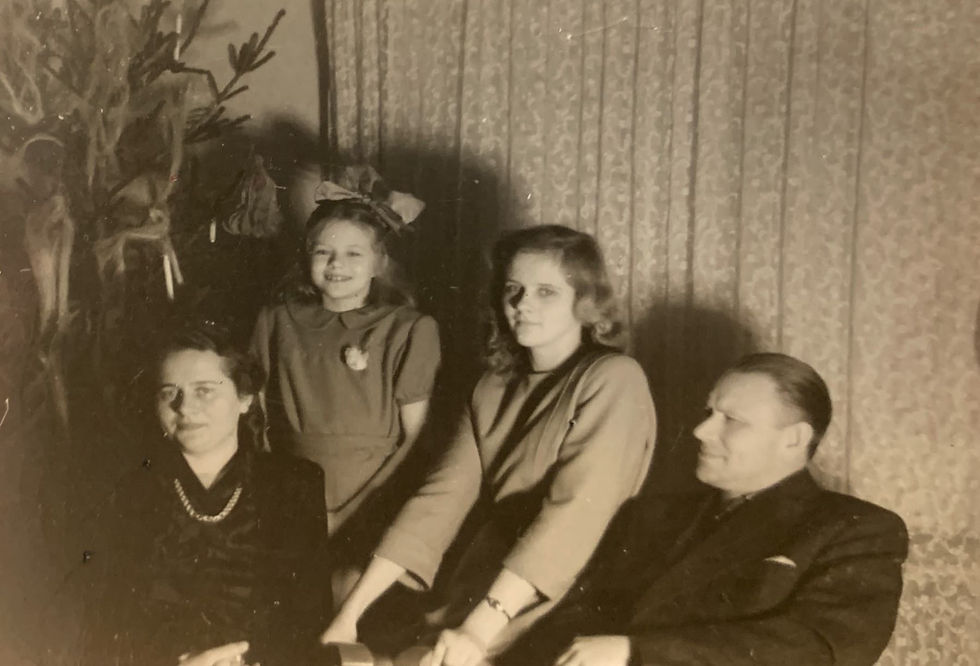
More challenges were faced as sister Virve contracted diphtheria, a highly contagious disease, while the family was traveling. Urve and her mother needed to stay in quarantine for some time, while Virve recovered in hospital.
The family then moved into an apartment in Stockholm before eventually making the decision to pick up and enter unknown territory once more – this time on a boat to Canada. The Mundis had friends in Montreal, so they settled in that city.
She credits her mother for imbuing her daughter with an indefatigable spirit. “When we are faced with problems in our lives, we don’t know the strength we have,” Urve
said. “My mother was an eternal optimist and I believe I have inherited this quality.”
That would prove to be true many times over.
Life in Canada begins to unfold
Many Estonians settled in Montreal, and the family quickly got established and became active in the community.

“My mother first began working as a dressmaker and, after taking some courses, moved on to become a bookkeeper,” she recounts. “My father was a bank inspector with the Bank of Estonia in Tallinn, and was able to secure a position with the Bank of Montreal.”
A remarkable leader enters her life
Urve was involved with the Estonian girl guides (hellakesed) and became a leader at the young age of 14. Meetings would be held in the Mundi home, and it was here that she met another woman who would become a strong influence in her life.
Frida Kasper, who was a girl guide leader in Estonia, had also settled in Montreal and took the girls under her wing. Tragically, she had lost her son while making the dangerous escape journey from Estonia to Sweden via boat. Her young child fell into a rough sea when people were being transferred from one boat to another and couldn’t be recovered.
“Frida really understood young people, she was an incredible leader,” Urve said. “So many
people came through difficult circumstances to get here, and we refugees have brought
different strengths to this country.”
Urve’s multi-faceted career path begins
Urve went on to study physiotherapy at McGill University, and met her first husband, a brain surgeon, while studying there.
In an incredible twist of fate, Urve was diagnosed with a pituitary brain tumour some years later, but thanks to medical advances, surgery successfully removed it.
A serious car accident, which propelled her through the car’s windshield, left her unable to continue as a physiotherapist. She went on to not just change careers, but to create new opportunities. And today, at 88 years of age, she is looking forward to more years of good health.
Dinner with friends at the 2000 Estonian World Festival; at Urve's Quebec cottage with grand nieces and nephews.
A lifelong interest in the arts led her to create the Montreal Visual Arts Centre and become its first Executive Director. Could it have been because of the “kasitöö” seed that had been planted so many years ago as a hellakene?
“At this time in the early 1970s, there was no other such centre that focused on applied arts in Quebec,” she said. “We were able to nurture these art forms and promote them in exciting ways.”
But that challenge was not her last. She turned her attention to social justice and went on to become the Director of the YWCA in Montreal, focusing on women’s issues.
“We served women at many different levels,” she recalls. “It was difficult but very rewarding work.” Perhaps she was carrying the torch from Frida’s influence, which began in her parents’ home in Montreal under the positive force of her mother, Aide.
Most people would have slowed down at this stage, but not Urve. When she and her second husband Francois Pierre moved to Ottawa, she pivoted again, and took a position at the Canadian Nurses Association. She called on her background in the health care field to steer a major expansion project for the organization.
After she retired, she and her husband moved to France, where they lived part-time for 15 years. “There we enjoyed the French culture, surrounded by my husband’s friends and family,” she said.
KESKUS is next on Urve’s horizon

Urve has joined other donor community trailblazers at the Viru Vanemad level supporter of KESKUS. She has lived in Ottawa for a number of years, and while the Estonian community remains active, it has certainly diminished in size. She is the former President of the Estonian Society in Ottawa and remarks how she has seen Estonians carry the spirit of their homeland through the generations. And having a home in which to do this will help tremendously.
“When I learned of KESKUS, I found it to be a fascinating and highly worthwhile project,” she said. “I feel very strongly that developing this new home for our community is a positive and important step. We need to maintain our Estonian identity.”
She is also full of praise for the design of KESKUS. “The planning and architecture of the building has been done so well. It’s just fabulous.”
“I can’t wait to go to KESKUS!”
Discover the benefits of giving wisely
Please join the growing list of KESKUS capital campaign donors to help bring this extraordinary project to completion. KESKUS leadership donors are recognized here.
There are many ways to make a contribution to KESKUS.
To donate, click here, or call +1.647.250.7136 or email donations@estoniancentre.ca. Donations may be made as a family gift, or in honour of an individual or family. All donations are issued a tax receipt, in Canada via Estonian Arts Centre, US tax receipts via Myriad USA and Estonian tax receipts via Eesti Rahvuskultuuri Fond. Donations by credit card may be made here.
Legacy gifts made to the Estonian Arts Centre, the charity associated with KESKUS, are creative and tax-effective ways to provide support. These are known as “planned gifts” because with thoughtful planning, we create a win-win situation that benefits both you and our community for generations to come. Find out how to provide a bequest in your will by going to www.estoniancentre.ca/bequest.
For information on making other types of planned gifts, including gifts of appreciated securities or insurance policies, or if you have any other questions, please contact EAC Donations Manager Taimi Hooper via email at donations@estoniancentre.ca or phone +1.647.250.7136.
Let’s keep in touch


